Building an authentication helper library for JupyterHub

2i2c have been working with the University of Toronto to add support for logging in to a JupyterHub using Canvas as an Identity Provider. JupyterHub implements support for authenticating users (figuring out who there are) and authorizing users (figuring out whether they are permitted to log into the hub) using an Authenicator interface. Via the oauthenticator package, JupyterHub has support for many kinds of OAuth2-based Identity Providers such as Google or GitHub, in addition to providing a generic authenticator GenericOAuthenticator that can be used with any OAuth2 implementation.
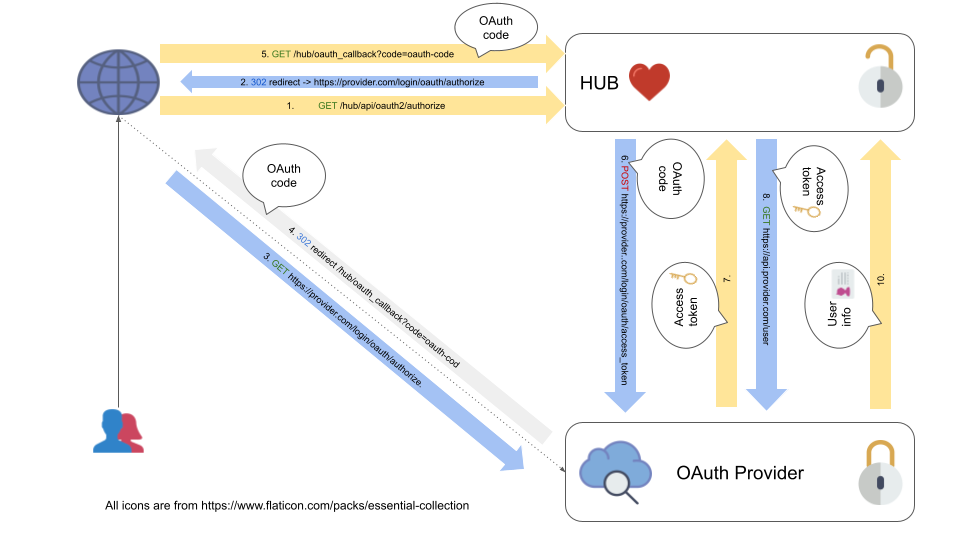.](/blog/buliding-jhub-authz/oauth-flow_hu0c8a8127bb8c611237d98151170d7a50_76835_3b90dd686be44dc5e5271fe8b6a74d81.webp)
Our friends at UC Berkeley maintain the CanvasOAuthenticator project, an implementation of a Canvas OAuth2 authenticator for JupyterHub. This project has been in-use by UC Berkeley for over four years, authenticating thousands of students. In the time since CanvasOAuthenticator was first written (with involvement from 2i2c members), the GenericOAuthenticator has seen significant improvements, such that it is now possible to implement Canvas authentication without maintaining an entirely dedicated authenticator project.
After recognizing that it is much easier to maintain a small set of OAuth2 rules (adaptors) for each Identity Provider (like Canvas) rather than full-blown authenticators, 2i2c built jupyterhub_oauthenticator_authz_helpers. This library maintains an implementation of a subset of UC Berkeley’s CanvasOAuthenticator rules for mapping Canvas courses and groups onto JupyterHub groups. With this work, adding Canvas authentication requires only a few additional lines:
from jupyterhub_oauthenticator_authz_helpers.canvas build_auth_urls

cfg = c.GenericOAuthenticator

canvas_url = "<CANVAS-URL>"

# Configure auths
cfg.authorize_url, cfg.token_url, cfg.userdata_url = build_auth_urls(canvas_url)

# Scopes that this token will need
cfg.scope = [*build_auth_urls.scopes]
Adding support for group population (from Canvas groups and courses) requires a little bit more config:
from jupyterhub_oauthenticator_authz_helpers.canvas get_user_groups, get_course_groups, build_auth_urls

# ...

# Define a custom key for auth groups
cfg.auth_state_groups_key = "custom-groups"

# Define and inject auth state
async def auth_state_hook(authenticator, auth_state):
  if auth_state is None:
    return None

  access_token = auth_state["access_token"]
  auth_state[authenticator.auth_state_groups_key] = [
    # Populate groups from Canvas courses, using the scheme defined in get_course_groups
    *await get_course_groups(canvas_url, access_token, "course_code"),
    # Populate groups from Canvas groups, using the scheme defined in get_user_groups
    *await get_user_groups(canvas_url, access_token),
  ]
  return auth_state

cfg.modify_auth_state_hook = auth_state_hook

# Request additional scopes for the course / user group fetching
cfg.scope = [*build_auth_urls.scopes, *get_user_groups.scopes, *get_course_groups.scopes]
In addition to building out this library, 2i2c hopes to foster collaboration with other users and maintainers to continue to upstream additional OAuth2 adaptors. As part of the funded initiative, 2i2c will spend time conducting gonvernance and community work upstream to establish a jupyterhub-contrib organisation that provides stewardship and maintainance of this work, and future third-party projects.
Acknowledgements #
- Thanks to the University of Toronto for collaborating with us, and funding this work.
- Thanks to UC Berkeley for the prior work that inspired this project.
Thanks for reading! If you'd like to follow our work, join our mailing list or subscribe to our blog. You can read our community hub documentation or learn about membership.